How to Make to Fresh Lasagna Noodles (1-hour)
If making lasagna noodles from scratch feels daunting, then rest easy, my friend! I'm sharing my step-by-step guide for no-cook, fresh lasagna noodles. A pasta attachment for the stand mixer make the whole process super simple and pretty foolproof and you can be making lasagna in about an hour.
Servings 1.5 lb dough
Ingredients
- 2 ⅓ cups 00 flour I use King Arthur's Pizza Flour; see below
- ⅔ cup semolina flour I use Bob's Red Mill semolina flour
- 3 egg yolks + 2 eggs
- 2 T water up to approximately ⅓ cup
Instructions
1. Prep the pasta attachment
- Lift the round KA logo and loosen the bolt on the right side of the logo to create enough space to accept the pasta roller. Fit the end of the roller into the opening and tighten the screw. You might have to turn the roller ¼ turn to fit.
2. Mix the pasta dough (see notes section below to use a stand mixer)
- Combine the flours in a bowl until thoroughly combined. Reserve 1 cup of flour. Pour the flours onto a clean cutting board or countertop in a mound. Make a well in the center of the flour using the bottom of a measuring cup, leaving flour at the bottom. You don’t want to see the cutting board.Beat the eggs in a bowl (or if you forget like I did, that’s ok!) Pour the beaten eggs into the well.
- Use a fork to pull flour from the sides into the egg, whisking the flour into the eggs. Keep working the flour into the egg until you don’t see any runny egg. Surround the dough with your hands and bring it together making a ball.
- Add enough water (a tablespoon at a time) to make a smooth dough. Keep rolling the dough, adding more flour as needed. Don't worry if you don't use all the flour. The amount might fluctuate based on the weather. See note below*
- Roll the dough by pulling it towards you, make a quarter turn, and push it away.
- Keep pulling in more flour as needed. You might need as much as a cup more! Keep rolling until the pasta dough is smooth.
- Lightly flour the dough and allow it to relax, covered with a damp dish towel or wrapped in plastic wrap for 15-20 minutes.
- Cut the pasta dough into 6 equal pieces. Work with one piece of dough and recover with plastic wrap so it doesn't dry out.
- Flatten the piece of pasta dough into a rectangle about 2” smaller than the width of the pasta roller, about ½”thick. Your dough might look a little "salty" from the semolina. This will smooth out.
3. Roll the pasta sheets
- Turn the dial on the roller to “1” which is the widest setting. Turn on the mixer to “low”.
- Place the short end of the dough into the opening of the pasta roller and allow the power of the pasta roller to pull the dough through the machine. Catch the dough below on the bottom or other side of the roller.
- “Book” the dough, which means folding each short end towards the middle and run it through the roller. Don't "rebook" it but run the same piece through the pasta roller at setting #1 again.
- Now, turn the knob to “2” and run the dough through the machine. Book the dough and run it through a second time.
- Repeat the booking and rolling process running the dough through the machine to setting #6. The piece of dough is going to get longer but don't worry as you're going to cut it the length you need.
NOTE: How to know the dough is the right thickness
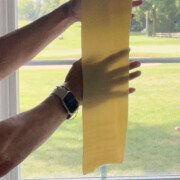
- While the dough is on the pasta roller, You'll know it's the right thickness when you can see a shadow of your hand behind the dough while holding it up to a window or light.
4. Cut the noodles
- Cut the noodles to fit the length of your lasagna pan and use the number of noodles (2 -2½) to fit across the width of the pan, not overlapping too much.
5. Cook the lasagna noodles (optional)
- Bring a stockpot of water to a rolling boil. Season generously with kosher salt (generous means a handful!).
- Gently add the pasta to the pot, one noodle at a time.
- Lightly stir with a wooden spoon and cook for 2-3 minutes until the pasta is al dente. Test one piece. It should have a firm bite and not be mushy. You’ll know!
Notes
Based off reader reviews, I recommend doubling or making 1.5x the recipe if using a deep dish lasagna pan to make more layers. You can always freeze the unused dough if you find you have enough noodles.
Flour /water notes
- You may not use all the flour as it depends on the weather.
- If you only have access to all purpose flour, that's ok to substitute it for the "00" flour but do not substitute for the semolina.
- I typically use AP flour to dust my board.
- You might use up to 1/3 cup of water. Start a tablespoon at a time.
My favorite tools for making lasagna noodles are a combo of:
- Your hands. The best tool in your kitchen. Period. And they are also the best tool for making amazing pasta dough at home because feeling the dough is key for knowing when the dough is ready.
- Kitchenaid pasta attachment. This pasta roller literally changed my pasta-making life. Because there’s no cranking, you can use both hands to run the dough through the machine.
- A clean work surface. Either a clean countertop or cutting board.
- A bench scraper. Comes in handy when gathering the flour on your work surface.
-
- Using the paddle attachment, combine the flours together in the mixer bowl on low until the flours are well blended.
-
- Stop the mixer. Crack the eggs and egg yolks into the flour mixture. Turn the mixer on low and mix the eggs into the flour. Add water as needed (up to 1/3 cup per above).
- Change to the dough hook attachment and continue kneading until the dough is smooth.
